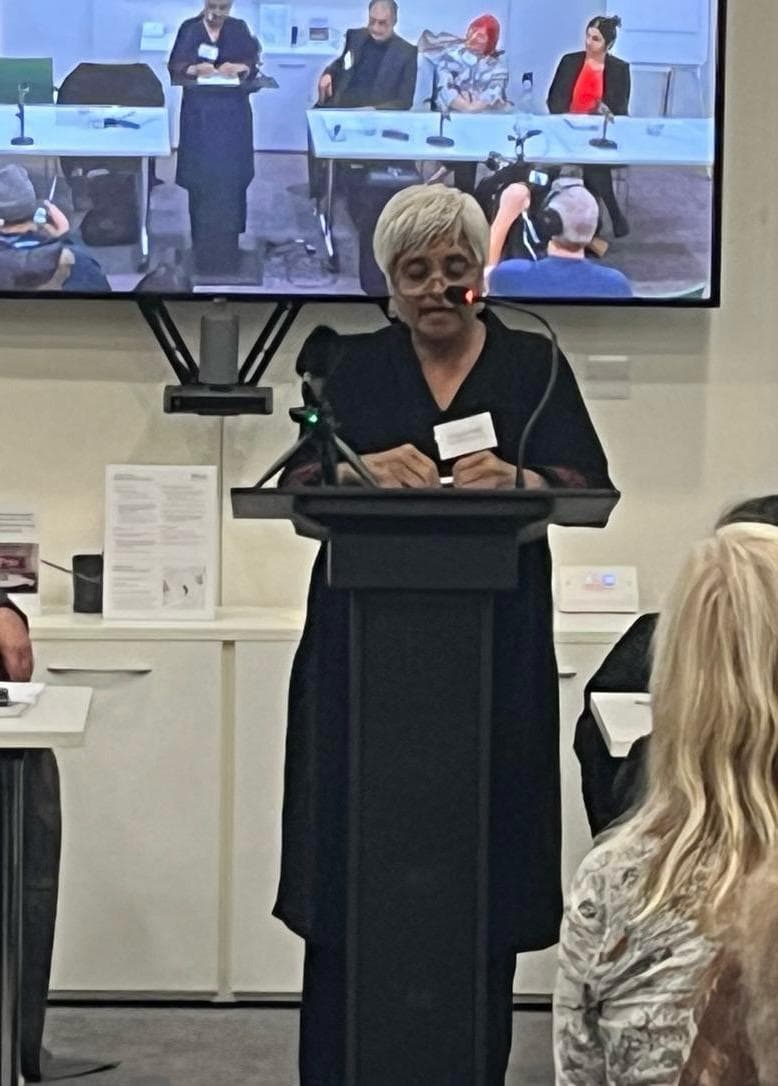
This speech was delivered by Pragna Patel at an event in solidarity with Rajiv Menon in London on 20 October.
I cannot imagine the personal anguish and distress that Rajiv and his family must be going through, but what I do know is that the political implications of this case are so grave that the rest of us cannot afford to be bystanders to what has unfolded.
It is clear that the attack on Rajiv is not just about the principle that juries have a right to act in accordance with their conscience. It is perhaps more about the political context in which this whole sorry affair has taken place: the genocide that has taken place in Palestine and the ongoing complicity of the British state. As the chair of the Criminal Bar Association put it and I quote: “It is starting to feel like it’s about the politics of the subject matter of the trial, rather than the core principles of how a barrister represents his client.”
What has taken place lays bare the interwoven themes of protest, dissent and judicial abuse of power. What happens next has serious ramifications for the rule of law and for the health of our democracy and the threat that this poses for all of us.
A few days ago, as I sat down to put my thoughts together, I saw what that threat looks like in India, as the state unleashed the full might of its coercive power to curtail freedom of speech, freedom of movement and freedom of protest against the many thousands of young people who have risen up to defend universal suffrage and other democratic principles of the Indian constitution.
Similarly, across the world, we are witness to unprecedented levels of political churning that serve as clear warning signs of democracy in decline. The last decade or more has seen an alarming slide towards authoritarianism from which the UK is clearly not immune. We have seen the introduction of numerous powers and laws that criminalise the right to protest, curtail freedom of speech and erode fundamental principles of law. What is at stake is our wider right to civil and political participation and our ability to hold power to account.
At the same time, we are also witness to an immense global fight back by ordinary people: a fight back against state repression and attempts to clamp down on protests about injustice, widening inequality, institutional overreach and corruption. What this tells us is that democracy is fragile, but it is still highly valued: there are no guarantees of its survival but there is a strong desire to protect it.
This is why I have come here today, not just to stand in solidarity with Rajiv but to fight for the very soul of democracy which is now in peril in the UK as in most parts of the world.
Dissent and Feminism
As we said in the statement put out by Project Resist in defence of Rajiv: “As women’s rights defenders, we have a duty to speak out and stop his persecution. Now more than ever, we need to come together in collective defence of Rajiv Menon and, by extension, our own rights as well as those of others who are under assault in the UK and elsewhere.”
This statement – signed by many black and minoritised women’s organisations as well as others – reflected our concern as feminists about the core issue at the heart of the case: the right to dissent.
As we made clear in our statement, we cannot divorce the wider anti-democratic trends that this case embodies from our day-to-day concerns about violence against women and women’s freedoms. Our right to exercise autonomy and self-determination in all aspects of our lives, rests upon the very principle of the right to dissent.
Dissent is a feminist issue because freedom of speech, freedom to protest and freedom of movement are not just core aspects of the rule of law but also of gender justice. Over the years, our public protests about violence against women have always been expressions of dissent against patriarchal values and state indifference that normalise the widespread brutality against women, within our communities and in the wider society. Our feminist protests have become a way by which we have sought to ensure that long suppressed accounts of women’s oppression and violence are brought to light in the public sphere so that they can be taken seriously.
When we took to the streets in 1984 to protest against the death of Krishna Sharma - an Asian woman from Southall who had taken her own life due to domestic abuse - we asked: who gets to define the norms of the community? We challenged the misogynist notions of honour and shame that force women to internalise abuse and keep them in the grip of oppression. Our public demonstration outside the home of Krishna Sharma’s abusive partner and in-laws was the only means we had to subvert the notions of honour and shame so that they attached, not to the abused women, but to their abusers. In the words of Gisèle Pelicot, we were trying to force shame to change sides.
Our current campaign on domestic abuse-related suicides continues our tradition of dissent and protest. In a context where domestic abuse-related suicides have overtaken domestic abuse-related homicides, many bereaved families from diverse backgrounds have come together with Project Resist to challenge the law for failing to hold abusive perpetrators to account. In essence, we continue to dissent from and challenge a culture of impunity and complicity in which violence against women thrives.
Similarly, when we took on the high-profile case of Kiranjit Ahluwalia who had killed her husband after years of abuse, we campaigned again in very public ways to highlight the inherently sexist nature of homicide defences in criminal law which remained inaccessible to abused women.
I have to say, the lively and colourful protests that we mounted outside the Court of Appeal in support of Kiranjit in 1992 were some of the high points of feminist activism of the early 90s, serving to bring about greater awareness of the violence against women in society. They played a central role in overturning her conviction for murder and in transforming her into a symbol of inspiration and hope for countless abused women from all backgrounds.
The politics of dissent was also central to the formation in 1989 of Women Against Fundamentalism (WAF), a feminist campaigning group that was born in response to the unprecedented political backlash surrounding Salman Rushdie’s book, The Satanic Verses: a backlash which came to epitomise the rise of religious fundamentalisms across the world.
WAF defined fundamentalism as modern political movements that manipulate religion for regressive political goals, at the heart of which is the desire to create a new sexual order that rests on the control of women’s minds and bodies.
The logical outcome of such religious fundamentalist ideology is the creation of gender apartheid regimes as we are now seeing in countries like Afghanistan and Iran. In the UK, the rise of the Religious Right and religious identity politics has also gone hand in hand with increased regulation and policing of female sexuality, using violence and intimidation if necessary.
As feminists, we drew connections between Rushdie’s right to dissent and the feminist tradition of dissenting upon which our right to private and public liberty and security rests. This is why our placards in support of Rushdie consisted of slogans such as: ‘Here to Stay, Here to Doubt’; ‘Fear is your Weapon, Courage is ours’; ‘Our tradition, Struggle not Submission’. We recognised that protest and dissent are the only real weapons we have in our struggle against the politics of religious fundamentalism.
What we didn’t fully appreciate back then is the extent to which both the Religious and Far Right forces that we confronted all those years ago have since gained ascendancy and entered the mainstream. In the West, the Far-Right targets migrants, Muslims and other minoritised groups that threaten their monocultural and ethno-nationalist world view. The Religious Right, on the other hand, denounce feminists, secularists, humanists, atheists, LGBT groups and other religious and ethnic minorities who do not conform to their ideology and/or those whose lifestyles are deemed to be ‘westernised’.
The febrile political climate that has since enveloped us has of course been stoked by austerity, Brexit, and the ever-increasing hostile anti-immigration and asylum rhetoric and policies of successive governments that have themselves taken an authoritarian turn.
Conclusion
In conclusion, historically, women have always utilised democratic and human rights values to fight for our right to be protected from harm and to be included as equals in the democratic settlement. Women’s rights depend on the health of our democracy and the right to dissent is at the core of it. It is not just a democratic principle. It is democracy in action. It is precisely because of this that the assault on Rajiv Menon matters to all of us in our struggles for peace, dignity, security and justice. His vindication will be our vindication but equally his defeat would be our defeat.